QuantForge
Python · Event-Driven Simulation · Quant Research
QuantForge
Backtests that can be replayed, hashed, and reproduced.
A deterministic Python event-driven research engine with causal execution rules, Decimal accounting, and reproducible synthetic scenarios, served through FastAPI to an interactive Next.js terminal.
01 — The Research Problem
The Research Problem
A chart of a backtest is not evidence unless the run can be replayed, the timing can be audited, and the ledger does not drift.
A signal
against Information it was not allowed to see
One interesting run
against A run someone else can rebuild
Floating-point cash
against A ledger that stays on its quantum
A summary metric
against The event that produced it
02 — Architecture
Architecture
The terminal never talks to an exchange. It asks a same-origin proxy for an allow-listed route, and FastAPI runs the engine.
- Next.js terminal
- Allow-listed API proxy
- FastAPI
- Backtest engine
- Analytics
- GET
/api/healthService status - GET
/api/configBounds, scenarios, strategies - POST
/api/backtestOne run, with its event trace - POST
/api/compareStrategies across cost presets - GET
/api/research-blockEmpirical-study gate
03 — Causal Event Loop
Causal Event Loop
Each timestamp is handled in a fixed phase order. A signal cannot trade on the bar that produced it.
01
Bar open
Only the open is revealed.
02
Fill due
Fill, or expire, at this open.
03
Bar complete
The prior bar's OHLCV is released.
04
Signal
The strategy decision becomes available.
05
Submit
Place, reject, or cancel one order.
06
Valuation
Mark equity at the observed price.
- A signal is available one hour after its decision bar opens.
- A submitted order is due one bar later, and fills at that bar's open.
- If that open is missing, the order expires instead of sliding forward.
- Strategies read only observations up to the decision bar.
04 — Deterministic Scenarios
Deterministic Scenarios
The terminal's prices are generated. The same seed rebuilds the same bars, and the run's identity does not depend on the wall clock.
The seed is an integer offset into a fixed wave table. The generator does not draw random numbers.
Scenario
Generator, seed, length, name, and clock.
Run
Assumptions, signals, and the full bar series.
Order / fill
Each order and fill has its own identity.
Experiment
Binds the run identities for the terminal session.
Identities are SHA-256 hashes of canonical JSON.
05 — Decimal Ledger
Decimal Ledger
Cash, quantity, fees, and prices are Decimal values. Risk ratios are the exception: volatility, Sharpe, and Sortino are computed in binary floating point and can be left undefined when the hourly grid is incomplete.
- Accounting context uses 50 digits of precision.
- Cash and quantity sit on a 0.00000001 quantum.
- Buy quantity rounds down. Buy debit and fees round up.
- Sell proceeds round down after the fee is rounded up.
- Cash and quantity cannot go negative.
- Marked equity equals cash plus quantity times the mark price.
- The ledger reconciles with fills at the end of the run.
The book is long or flat, and all-in. It does not short and it does not use leverage. The default starting cash is 10,000.
These are metrics the engine can compute. This page does not report a result for any of them.
06 — Research Terminal
Research Terminal
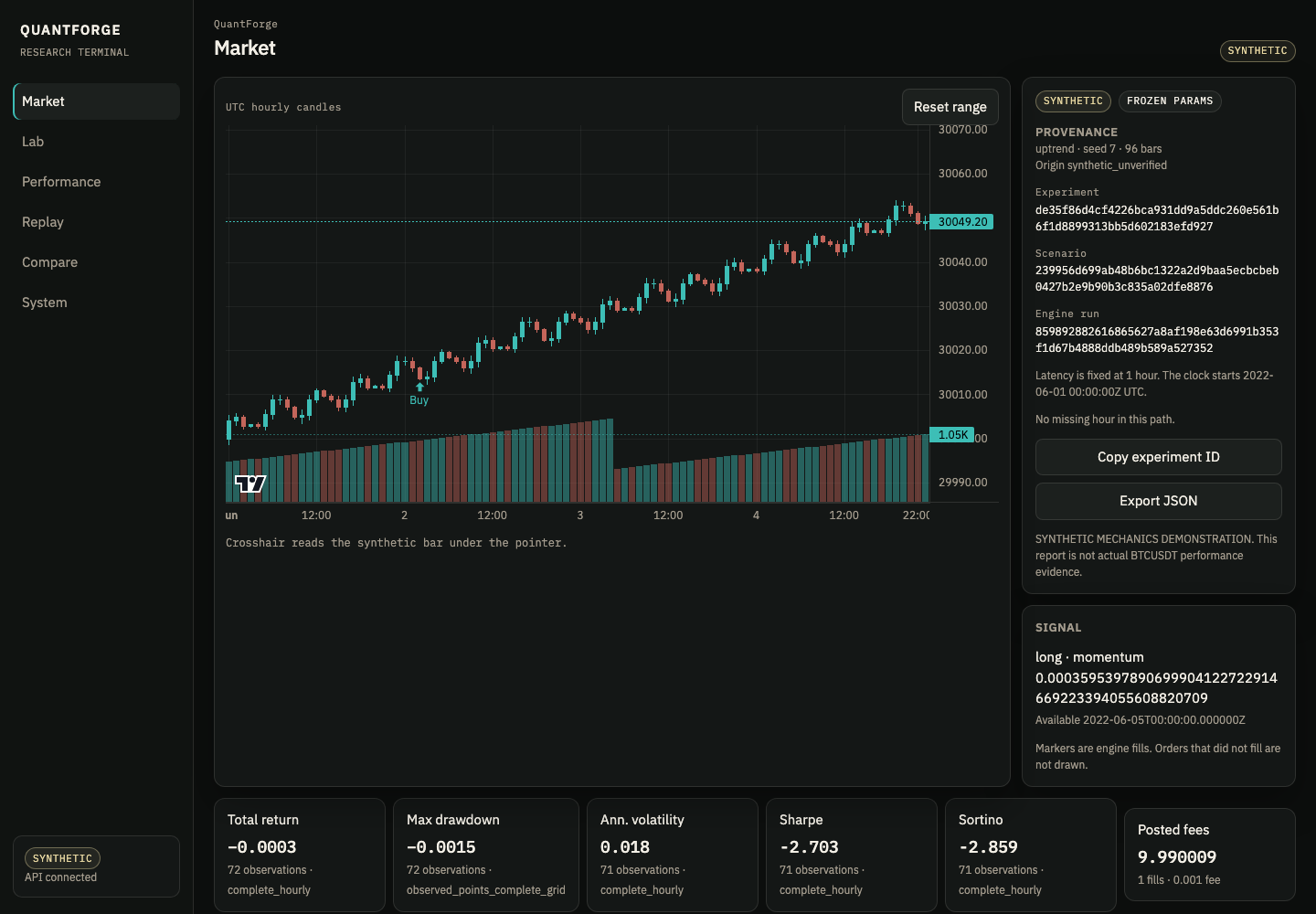
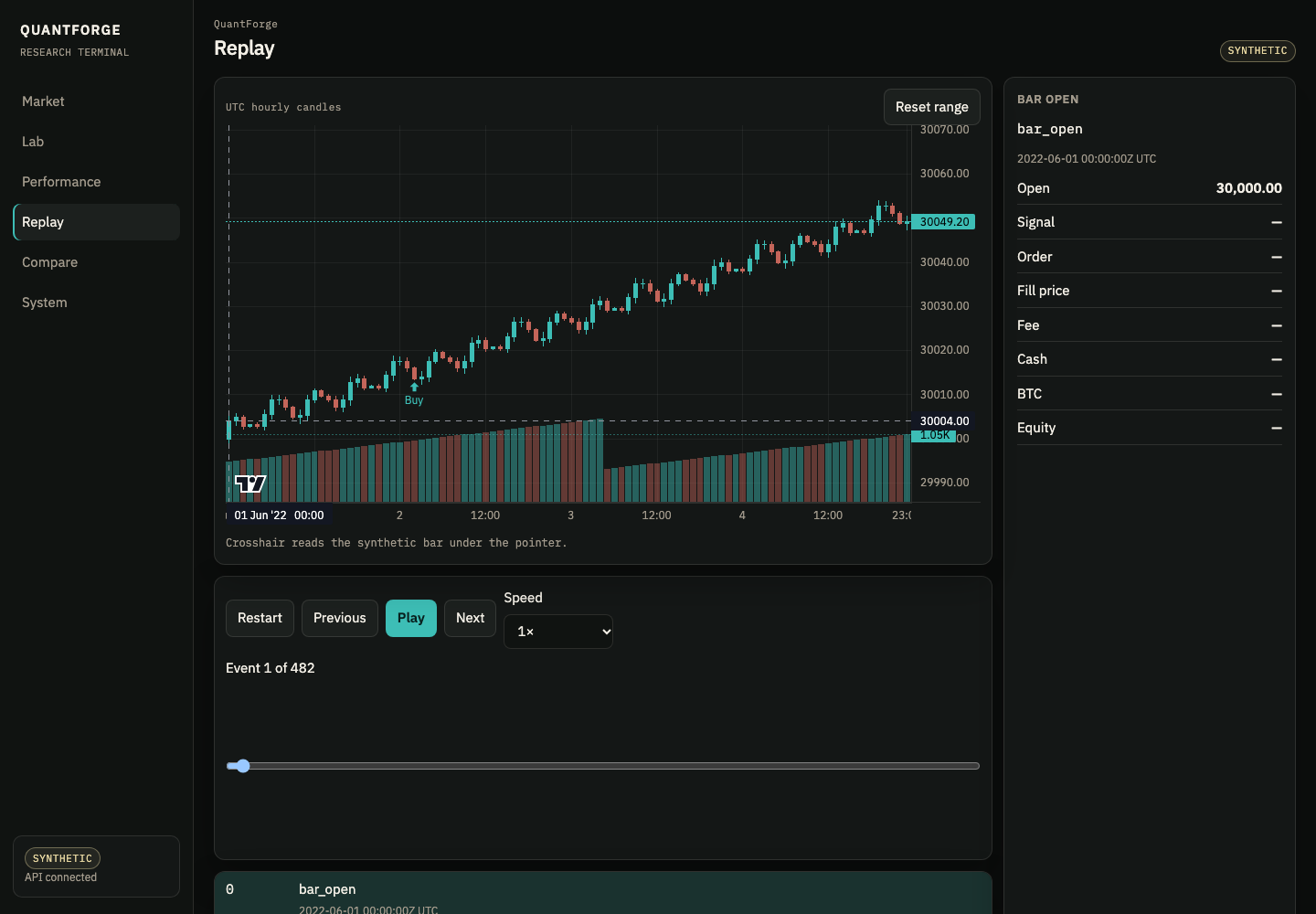
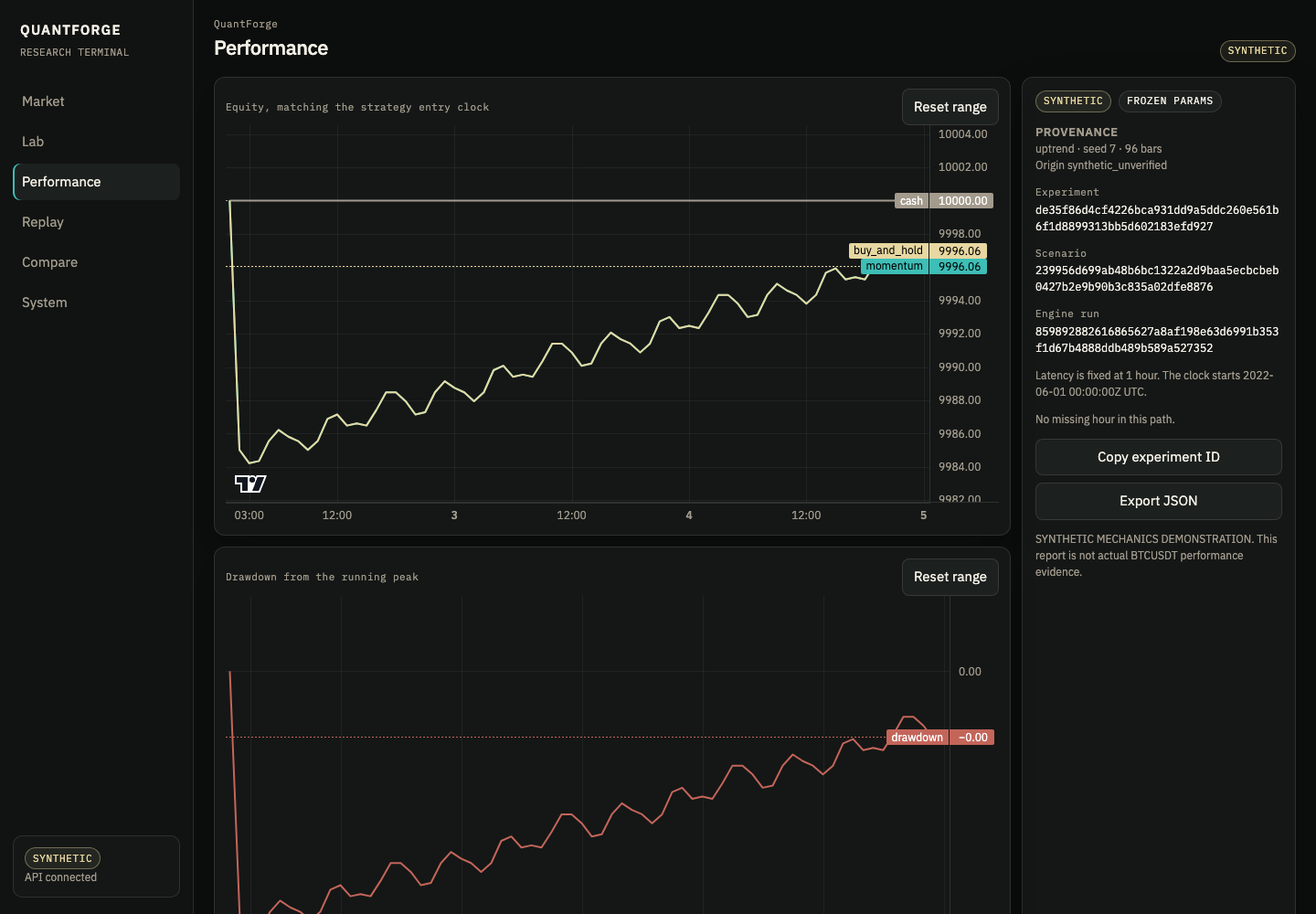
Six workspaces sit on the same run. The screenshots are from the deployed terminal, on a synthetic uptrend scenario. The numbers in them belong to that generated path.
Market
Candles, volume, and fill markers.
Lab
Strategy, scenario, seed, and cost preset.
Performance
Equity against cash and buy-and-hold, plus drawdown.
Replay
Step through the engine's own events.
Compare
Both strategies across cost presets. Nothing is ranked.
System
Architecture, causal timing, and the research gate.
07 — Engineering Proof
Engineering Proof
Causal timing
Tests reject a fill that uses a future close, and a signal that acts before it is available.
Replay identity
The same inputs rebuild the same run identity. Changing the fee changes it.
Byte-identical demo
Continuous integration builds the wheel, runs the demo twice, and compares the outputs.
Terminal checks
The web job typechecks, lints, tests, and builds the Next.js terminal.
A numeric pytest total is omitted. The repository's published totals do not currently agree, so this page does not pick one.
- The deployed terminal runs synthetic scenarios. It is not a historical BTCUSDT study.
- No return, Sharpe, or drawdown on this page is a market result.
- The engine does not place live orders.
- Archive-ingestion code exists and is held behind a research gate. No real-data validation is claimed.